
Learn › Life cycle › The Jewish wedding
Ketubah and Wedding Ring: The Jewish Marriage Contract Explained
What a ketubah is, what it says, who signs it, and why a Jewish wedding ring is a plain band given under the chuppah.
Part 10 of 21 · Love and marriage, step by step
On this page · 2 min read
What the ketubah saysWho signs itThe wedding ringThe order of the ceremonyA ketubah is the Jewish marriage contract, written in Aramaic, in which the groom commits to care for and support his wife. It is signed by two witnesses before the ceremony, read aloud under the chuppah, and given to the bride to keep for life.
What the ketubah says
The ketubah sets out the groom's obligations to his wife, which the Torah and the Sages require of every Jewish husband: to provide food, clothing and a home, to respect her, to be close to her, and to provide for her if the marriage ends. It records the date in the Hebrew calendar, the place, and the names of the bride, the groom and their fathers.
The Sages instituted the ketubah more than two thousand years ago to protect the wife. It made marriage a serious, binding commitment, and it is one of the earliest documents in history to give a wife legal rights.
Who signs it
The ketubah is signed by two witnesses, who must be observant Jewish men who are not related to the bride, the groom or each other. Before signing, the groom formally accepts the obligations through a kinyan, by lifting an object, usually a pen or handkerchief, handed to him by the Rabbi in front of the witnesses.
Many couples choose a beautifully decorated ketubah to hang in their home. The art is a matter of taste, but the text must be correct and filled in by someone who knows the laws, usually the Rabbi officiating.
The wedding ring
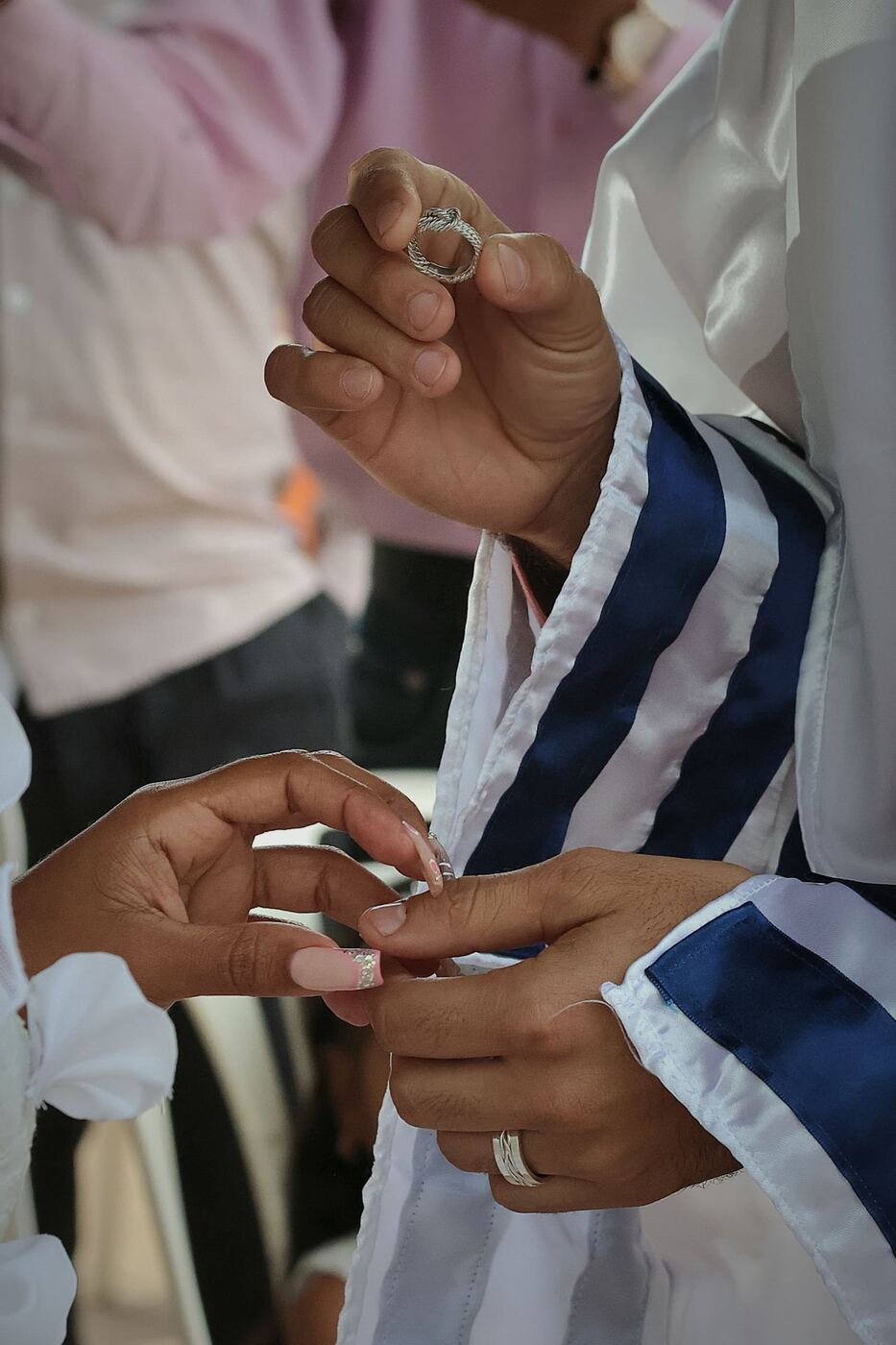
In a Jewish wedding, the groom "betroths" the bride by giving her something of value. The custom is to use a ring. Under the chuppah, he places it on the index finger of her right hand and says:
Hebrew: הֲרֵי אַתְּ מְקֻדֶּשֶׁת לִי בְּטַבַּעַת זוֹ כְּדַת משֶׁה וְיִשְׂרָאֵל
Transliteration: Harei at mekudeshet li b'taba'at zo k'dat Moshe v'Yisrael.
Translation: Behold, you are consecrated to me with this ring, according to the law of Moses and Israel.
The ring should be:
- A plain band of metal, usually gold, with no stones, so its value is clear and simple.
- Owned by the groom. It cannot be borrowed.
- Accepted willingly by the bride, in front of two witnesses.
After the ceremony, the bride may move the ring to whichever finger she likes.
The order of the ceremony
- The ketubah is prepared and signed by the witnesses.
- The groom covers the bride's face with her veil (badeken).
- Under the chuppah, blessings are said over wine.
- The groom gives the ring and says the betrothal words.
- The ketubah is read aloud and handed to the groom, who gives it to his bride.
- The Seven Blessings are said, and the groom breaks a glass.
Read more in our guides to the Jewish wedding and wedding customs.
In Lamorinda: Planning a Jewish wedding? Rabbi Labkowski can guide you through the ketubah, the ring and every part of the ceremony. Visit jewishlamorinda.com/help/getting-married or call 925-384-7242.
Common questions
Does the bride give the groom a ring?
In a traditional ceremony, only the groom gives a ring under the chuppah, since the Torah describes the groom betrothing the bride. Many brides give their husband a ring later, away from the ceremony. Ask the Rabbi if this matters to you.
Can we use a ring with diamonds or an heirloom?
Under the chuppah, a plain band is used. An engagement ring with stones is worn separately. An heirloom band can be used if it truly belongs to the groom; ask the Rabbi.
What if the ketubah is lost or damaged?
A couple may not live together without a ketubah, so a replacement must be written as soon as possible. Call the Rabbi, who can prepare one for you.
Can we write our own ketubah text?
The traditional text has binding legal meaning in Jewish law and should not be changed. If you would like to share personal words with each other, ask the Rabbi about the best way and moment to do it.
Step by step · Part 10 of 21
Love and marriage, step by step
NextFasting on Your Wedding Day: Why Bride and Groom Fast and How It EndsWhy do bride and groom fast on their wedding day? The "personal Yom Kippur," when the fast ends, days it is skipped and health exceptions. Ask the Rabbi.All 21 parts
- Jewish Dating: Finding Your Match the Jewish Way
- Bashert: Is There One Soulmate for Everyone?
- Jewish Engagement: The L'chaim, Tenaim and the Months Before the Wedding
- Tenaim: The Engagement Agreement and the Broken Plate
- A Jewish Wedding in Lafayette, Moraga or Orinda: Rabbi, Chuppah and Planning
- Choosing a Wedding Date: Jewish Calendar Guidelines
- Kallah Classes: Preparing for Marriage as a Jewish Bride
- Chosson Classes: Preparing for Marriage as a Jewish Groom
- What Is an Aufruf? The Groom's Torah Honor Before the Wedding
- Ketubah and Wedding Ring: The Jewish Marriage Contract Explained
- Fasting on Your Wedding Day: Why Bride and Groom Fast and How It Ends
- The Jewish Wedding: Traditions and Ceremony Explained Step by Step
- What Is a Chuppah? The Wedding Canopy and Its Meaning
- Jewish Wedding Customs and Traditions Explained
- Yichud: The Couple's First Minutes Alone After the Chuppah
- Attending a Jewish Wedding: A Guest's Guide
- Sheva Brachot: The Seven Wedding Blessings Explained
- The First Year of Marriage: Shana Rishona in Jewish Tradition
- Jewish Wedding Anniversary: Ways to Celebrate on Your Hebrew Date
- Shalom Bayit: Peace in the Jewish Home
- Marrying Again: A Jewish Guide to a Second Marriage
Questions about this, or something on your mind? Message the Rabbi or the Rebbetzin privately, or call 925-384-7242. · Email
Read next
 The Jewish Wedding: Traditions and Ceremony Explained Step by StepA step-by-step guide to the Jewish wedding: the ketubah, chuppah, ring, seven blessings, breaking the glass, and what they mean.Read next →