
Learn › Shabbat & holidays › Elul and Rosh Hashanah
The Binding of Isaac (Akeidah): The Story We Read on Rosh Hashanah
The Binding of Isaac, or Akeidah, explained: the story, why the shofar is a ram's horn and what it asks of us. Ask Chabad of Lamorinda.
Part 4 of 20 · The High Holidays, step by step
On this page · 3 min read
What happens in the storyWhat kind of test was this?The ram and the shofarWhat the Akeidah asks of usWhen the story troubles youThe Binding of Isaac, called the Akeidah (עֲקֵדָה, "binding"), is the Torah story in which G-d tests Abraham by asking him to offer his son Isaac, and then stops him at the last moment. Jews read it on the second day of Rosh Hashanah, and the ram's horn we blow, the shofar, recalls the ram that was offered in Isaac's place.
For families in Lafayette, Moraga and Orinda, it is a story that raises real questions. This guide tells it simply and shares how Chabad teaching understands it.
What happens in the story
The story is in Genesis, chapter 22. Abraham and Sarah had received Isaac miraculously, when Abraham was a hundred years old. Then G-d tells Abraham to take Isaac and offer him on a mountain.
Abraham rises early and sets out without delay. He binds Isaac on the altar. At the decisive moment a voice calls to stop: "Do not touch the child, and do nothing to him." Abraham sees a ram caught nearby and offers it instead. G-d says, "Now I know that you fear G-d."
Isaac lives. He and Abraham return home, and G-d renews his blessings to Abraham.
What kind of test was this?
Judaism forbids human sacrifice, and the story ends with G-d stopping it. The test was never about harming a child. It was about whether Abraham's devotion to G-d would outweigh even his deepest hopes and instincts.
Abraham had faced earlier tests, yet the Akeidah stands above them. The Talmud (Sanhedrin 89b) says G-d asked for this last test so that the earlier ones would not be seen as empty. Chassidic teaching adds that many people give their lives for something they care about, which is still a form of self-expression. Abraham was willing to set aside his self, including his own hopes for the future, because G-d asked. That is why the Akeidah is called the central image of Jewish devotion.
It is also why the Torah account is read in the daily morning prayers, so we recall it every day, not only on Rosh Hashanah.
The ram and the shofar
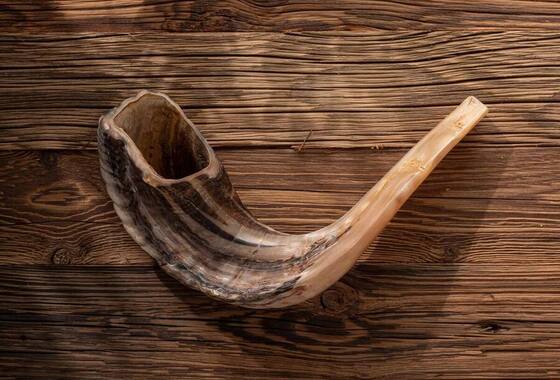
The ram that took Isaac's place is the reason the shofar is made from a ram's horn. On Rosh Hashanah, when the world is judged, the sound of the shofar is a plea. If we have little merit of our own, we ask G-d to remember Abraham's devotion and the covenant that began with him. Read more in the guide to the shofar and the Rosh Hashanah guide.
What the Akeidah asks of us
Most of us will never face a test like Abraham's. The story still invites a few quiet questions:
- What matters most to me? Abraham showed that devotion to G-d can outweigh even our strongest instincts.
- Can I act with trust when I do not understand? Abraham did not know where it would lead.
- Do my earlier efforts count? The Talmud teaches that the final test gave the earlier ones meaning. A single good decision today can give meaning to years of effort.
- Can I begin again? Rosh Hashanah is the day to renew our commitment. See teshuvah.
When the story troubles you
It is natural to find this story hard, especially as a parent. Jewish learning welcomes the question. The sages and Chassidic teachers have asked it for centuries, and it is fine to say the story is difficult. One thing every reading shares is that Isaac lives and the sacrifice is stopped.
If it troubles your child or you, please do not carry it alone. Speak with Rabbi Yisroel Labkowski or Rebbetzin Tzipora Labkowski. They would be glad to learn it with you.
In Lamorinda: Wondering about a hard question from the Torah? Call Rabbi Labkowski at 925-384-7242 or write via /help/talk-to-the-rabbi.
Common questions
What is the Binding of Isaac?
It is the story in Genesis 22 in which G-d asks Abraham to offer his son Isaac and then stops him at the last moment. A ram is offered in Isaac's place. In Hebrew it is called the Akeidah.
Why do Jews read the Akeidah on Rosh Hashanah?
Jews read it on the second day of Rosh Hashanah because the day is one of judgment, and Abraham's devotion is the merit we ask G-d to remember. The shofar blasts bring the story to mind.
Did G-d really want Abraham to sacrifice Isaac?
Judaism does not allow human sacrifice, and G-d stops Abraham before any harm is done. The Torah calls it a test of Abraham's devotion. For deeper questions, ask the Rabbi.
Why is the shofar a ram's horn?
The shofar recalls the ram that was offered in place of Isaac. Blowing it is a plea for G-d to remember Abraham's deed.
Where can I hear the shofar in Lafayette, Moraga or Orinda?
Call Chabad of Lamorinda in Lafayette at 925-384-7242 to hear what is planned for Rosh Hashanah. See also High Holiday services.
How do I explain the Akeidah to children?
Keep to the heart of the story: Abraham loves G-d, G-d stops him, and Isaac is safe. Then talk about trust. If a child is frightened, ask the Rabbi for help.
Take the next step
- Read the guide to the shofar and then Abraham and Sarah, where the story begins.
- Sign up for High Holiday services in Lafayette and hear the shofar in person.
- Bring your question to the Rabbi through talk to the Rabbi.
Step by step · Part 4 of 20
The High Holidays, step by step
NextRosh Hashanah Simanim: Apple and Honey and the Symbolic FoodsThe symbolic foods eaten on Rosh Hashanah night, from apple dipped in honey to pomegranate and fish head, with their meanings and blessings.All 20 parts
- The Month of Elul: How to Prepare for the High Holidays
- Selichot: The Prayers for Forgiveness Before Rosh Hashanah
- Rosh Hashanah for Beginners: Your First Jewish New Year
- The Binding of Isaac (Akeidah): The Story We Read on Rosh Hashanah
- Rosh Hashanah Simanim: Apple and Honey and the Symbolic Foods
- The Shofar: Why We Blow It on Rosh Hashanah and How to Hear It
- Unetaneh Tokef: "Who Will Live and Who Will Die" Explained
- Tashlich: The Rosh Hashanah Prayer by the Water
- The Ten Days of Repentance: Between Rosh Hashanah and Yom Kippur
- Avinu Malkeinu: Meaning of "Our Father, Our King" and When We Say It
- Shabbat Shuva: The Shabbat Between Rosh Hashanah and Yom Kippur
- Yom Kippur for Beginners: Your First Day of Atonement
- Yom Kippur With Kids: When Children Fast and How to Make the Day Meaningful
- Teshuvah: Repentance and Returning to G-d in Judaism
- Kapparot: The Custom Before Yom Kippur
- Erev Yom Kippur: Customs for the Day Before Yom Kippur
- Kol Nidre: Meaning, Time and What Happens
- The Book of Jonah: Story, Meaning and Why We Read It on Yom Kippur
- The Yom Kippur Fast: Rules, Tips and Who Is Exempt
- Neilah: The Closing Prayer of Yom Kippur and What Happens at Sunset
Questions about this, or something on your mind? Message the Rabbi or the Rebbetzin privately, or call 925-384-7242. · Email
Read next
 The Shofar: Why We Blow It on Rosh Hashanah and How to Hear ItWhat the shofar is, why it is blown on Rosh Hashanah, the meaning of its sounds, the blessing, and how to make sure you hear it.Read next →