

Parashat Ha'azinu
Deuteronomy · Deuteronomy 32:1-32:52
Parashat Ha'azinu האזינו
Most of this portion is a song that Moses teaches Israel on the last day of his life. He calls on the heavens and the earth as witnesses: Listen, O heavens, and I will speak; hear, O earth, the words of my mouth. He praises G-d, the Rock, whose work is perfect and whose ways are just. He asks the people to remember the days of old and to ask their parents and elders. G-d's portion is His people; Jacob is the lot of His inheritance. G-d found Israel in a desert land and cared for them like an eagle that stirs its nest and hovers over its young. The song foresees that when Israel becomes prosperous, they may forget G-d and turn to other gods, and that hardship will follow. Yet G-d will not destroy them, and in the end He will have compassion on His servants and bring atonement to His land. G-d then tells Moses to go up Mount Nebo, see the land from afar, and pass away there.
A lesson for today
For G-d's portion is His people. Chassidic teaching, especially the Tanya, explains that every Jewish soul is truly a part of G-d. This means that no Jew is ever truly disconnected from G-d, no matter how far he or she may seem. Moses told the people that these words are not an empty thing; they are your life. Ha'azinu is usually read between Rosh Hashanah and Sukkot, reminding us of the deep, unbreakable bond each of us has with G-d.
The Rebbe's teachingA storyIdeas for the Shabbat tableAn essay
The Rebbe's teaching
The Rebbe taught that the closeness to G-d we feel in the High Holiday season is a starting point, and that we are meant to carry it into the details of everyday life.
Ha'azinu opens with Moses' song: "Listen, O heavens, and I will speak; and let the earth hear the words of my mouth." The Rebbe, in a talk adapted in Likkutei Sichos, asked a question. Moses speaks to the heavens and the earth. The prophet Isaiah, centuries later, begins, "Hear, O heavens, and listen, O earth." Why did each of them address both? Why did Moses not speak only to the heavens, which are close to him, and Isaiah only to the earth?
The Rebbe explained that Judaism holds that spiritual and physical reality are meant to be connected, not kept apart. Moses' role was to draw the spiritual down into worldly life: with the Torah, every person can be "close to the heavens." Isaiah's role was to lift worldly life upward, so that a person can stay close to the heavens even while handling the details of material life. The two work in sequence.
The Rebbe linked this to the calendar. Ha'azinu is read in the Ten Days of Repentance, when closeness to G-d is most available. After Yom Kippur the focus turns earthward, toward building the sukkah and living in it, a mitzvah done inside physical materials. Closeness to the heavens, in other words, is a foundation and not a destination.
He applied the same pattern to learning and doing. Torah study brings us close to the heavens. But "study is not the essential thing; deed is." The Rebbe explains that study takes precedence in this era, and that deed will take precedence in the Era of Redemption, when the connection between heaven and earth is complete.
What this means for us: use the feeling of inspiration we get from the High Holidays as a launch pad. A good resolution made in the synagogue needs to become a kind word at home, a fair deal at work, a call we promise to make. See the Ten Days of Repentance and Sukkot for beginners.
A story
A well-known Chassidic story; its details cannot be confirmed. It is told in books of Chassidic tales such as Sipurei Chassidim.
A chassid was seriously ill. He had been to many doctors, and none had helped. His Rebbe told him to go and consult the professor in the town of Anipoli.
The chassid made the difficult journey. But when he arrived, he found no professor, no doctor, not even a medical attendant. He returned and reported to his Rebbe.
The Rebbe asked him: what do the people of Anipoli do when someone falls ill?
The chassid replied that they have no choice but to trust in G-d and ask Him to send healing from heaven.
The Rebbe said: "That is the professor I meant." The chassid should put his trust in G-d, who helps the people of Anipoli, and He would help him, too.
The story is told in connection with a verse from our portion in which G-d says, "I wound and I heal, and there is no rescuer from My hand." It is a story about trust, not medical advice: it says that G-d is the true Healer, and that trust in Him is the foundation. See trust in G-d. For a personal medical question, see your doctor; for the Jewish side of it, ask the Rabbi.
Ideas for the Shabbat table
- Ask everyone: how did you feel during the High Holidays this year? What is one feeling or resolution we want to keep after Yom Kippur?
- For children: Moses spoke to the sky and to the ground. What can the sky teach us? What can the ground teach us?
- Adults: Where in our week is there a gap between what we believe and what we do? What is one small step to close it?
- Discuss: the story says that the people of Anipoli had "no choice but to trust." What would it mean to trust in G-d even when we do have choices?
- Talk about it: the Rebbe says deed is the essence, not only study. Which mitzvah would you like to do more often?
- Try this: build or plan something concrete this week that carries a High Holiday resolution into the home, for example setting up a tzedakah box or deciding on a regular time to light Shabbat candles.
An essay
There is a moment, usually somewhere between Rosh Hashanah and Yom Kippur, when we feel we can almost reach up and touch the sky. We have fasted or prayed or sat quietly and thought about who we want to be. It feels clear, and it feels sincere. Then Yom Kippur ends, the dishes pile up, the phone rings, and the feeling fades.
Ha'azinu, read in these days, speaks precisely to that moment. The song of Moses begins with the heavens and the earth together. The Rebbe's lesson is that the aim of a spiritual life is not to stay in the clouds. The heavens are meant to shape the earth. Closeness to G-d is the beginning, and the work is to bring it down into everyday life.
That is why, right after the awe of Yom Kippur, the Jewish calendar sends us outside to build a sukkah. It is a humble hut made of boards and branches, and eating in it is a mitzvah. The holiness is meant to live in ordinary materials, our table, our meals, our home.
The story of the professor of Anipoli expresses the same thought from another angle. The chassid is sent far away to find a professor, and learns that the one he needs is already near. The people of Anipoli, with no other recourse, rely on G-d. The lesson is not that we should have no recourse, but that we should bring this trust into the places where we do have choices: at the hospital, at the office, at the kitchen table.
The Rebbe's teaching gives us a simple test for any inspiration: what will I do differently on Tuesday? A resolution that finds its way into a deed has done its job.
If you would like to bring some of this inspiration into your week, join us at Chabad of Lamorinda in Lafayette (call 925-384-7242 for Shabbat times), or at the Wednesday 1:00 PM Tanya class at the Rabbi's home (call for the address). Families from Lafayette, Moraga and Orinda are welcome.
Common questions
What is Parshat Ha'azinu about?
Parshat Ha'azinu (Deuteronomy 32:1-52) is Moses' song, in which he calls heaven and earth as witnesses, praises G-d as the faithful Rock, foresees Israel's straying and return, and then ascends Mount Nebo to see the land.
What does the Rebbe teach about Parshat Ha'azinu?
The Rebbe teaches that Moses and Isaiah both address heaven and earth because the spiritual and the material are meant to be connected, and that the closeness to G-d we feel in the Ten Days of Repentance should be carried into daily life through deeds.
What is the main lesson of Parshat Ha'azinu?
Closeness to G-d is a starting point: we are meant to bring it down into everyday actions. See the weekly parsha for how to study each portion.
Learn more
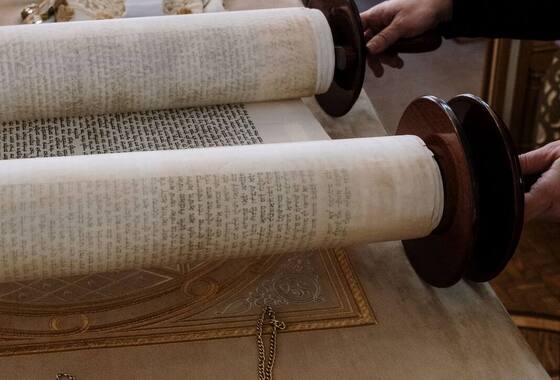 The Weekly Parsha: How the Torah Is Read Each WeekWhat the weekly Torah portion (parsha) is, how the 54 portions fit the Jewish year, and easy ways to study and discuss the parsha each week.
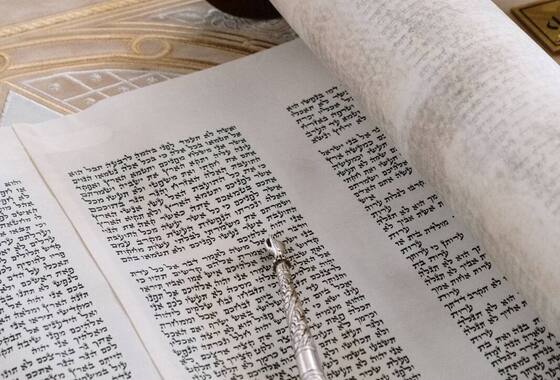 The Torah Reading in Synagogue: When, Why and HowWhen the Torah is read in synagogue, how the weekly cycle works, what happens during the reading, and what to do as it takes place.
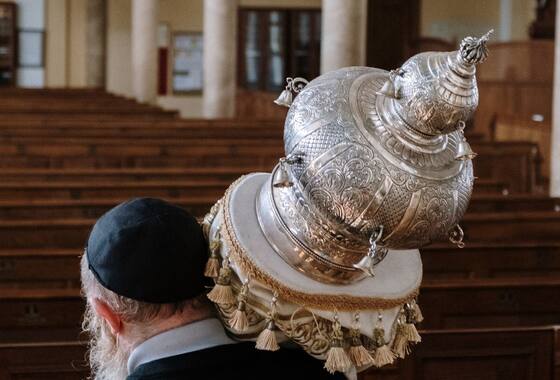 The Haftarah: What It Is and Why We Read ItWhat the Haftarah is, how it began, how it connects to the weekly Torah portion, who reads it, and what to know for a bar mitzvah.