
Stories and jokes › Faith and courage
Chanukah in Bergen-Belsen
In the concentration camp of Bergen-Belsen, on the eve of Chanukah, a selection took place. Early in the morning, three German commandants, meticulously dressed in their festive black uniforms and in visibly high spirits, entered the men's barracks. They ordered the men to stand at the foot of their three-tiered bunks, and the selection began. No papers were checked; there was no roll call and no head count. One of the commandants simply lifted an index finger in his snow-white glove, pointed at a pale face, and pronounced the death sentence in a single word: "Come!"
Like a barrage of machine-gun fire came the commands: "Komme, komme, komme, komme." The men selected were marched outside, where S.S. men with rubber truncheons and iron prods awaited them. They kicked, beat and tortured their innocent victims, and when a tortured body no longer responded, the revolver was used. The random selection went on inside the barracks, and the massacre outside, until sundown. When the black angels of death departed, they left behind heaps of hundreds of tortured, twisted bodies.
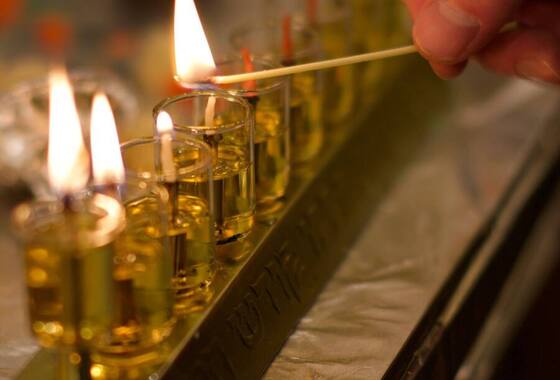
Then Chanukah came to Bergen-Belsen. It was time to kindle the Chanukah lights. There was no jug of oil to be found, no candle in sight, and a menorah belonged to the distant past. Instead, a wooden clog, the shoe of one of the inmates, became the menorah; strings pulled from a camp uniform, the wick; and black camp shoe polish, the oil. Not far from the heaps of bodies, the living skeletons gathered to take part in the kindling of the Chanukah lights.
The Rabbi of Bluzhov lit the first light and chanted the first two blessings in his pleasant voice, and the festive melody was filled with sorrow and pain. When he came to the third blessing, he stopped, turned his head and looked around, as if searching for something. Then he turned back to the quivering little lights and, in a strong, reassuring, comforting voice, chanted the third blessing: "Blessed are You, L-rd our G-d, King of the Universe, Who has kept us alive, and sustained us, and enabled us to reach this season."
Among those present was a Mr. Zamietchkowski, one of the leaders of the Warsaw Bund. He was a clever, sincere man with a passion for discussing religion, faith and truth, and even in Bergen-Belsen that passion had not faded; he never missed an opportunity for such a conversation. As soon as the Rabbi of Bluzhov had finished the kindling, Zamietchkowski elbowed his way over to him and said: "Spira, you are a clever and honest person. I can understand your need to light Chanukah candles in these wretched times. I can even understand the historical note of the second blessing, 'Who performed miracles for our fathers in days of old, at this season.' But the fact that you recited the third blessing is beyond me. How could you thank G-d and say 'Who has kept us alive, and sustained us, and enabled us to reach this season'? How could you say it when hundreds of dead Jewish bodies are literally lying in the shadow of the Chanukah lights, when thousands of living Jewish skeletons are walking around this camp, and millions more are being massacred? For this you are thankful to G-d? For this you praise Him? This you call 'keeping us alive'?"
"Zamietchkowski, you are a hundred percent right," answered the rabbi. "When I reached the third blessing, I also hesitated and asked myself, what should I do with this blessing? I turned my head to ask the Rabbi of Zaner and the other distinguished rabbis standing near me whether I might indeed recite it. But just as I turned my head, I noticed that behind me a throng was standing, a large crowd of living Jews, their faces expressing faith, devotion and concentration as they listened to the kindling of the Chanukah lights.
"I said to myself: if G-d, blessed be He, has such a nation, that at times like these, when during the lighting of the Chanukah lights they see before them the heaps of bodies of their fathers, brothers and sons, and death looks out from every corner, if despite all that they stand in throngs and listen with devotion to the blessing 'Who performed miracles for our fathers in days of old, at this season'; if I was indeed blessed to see such a people, with so much faith and fervor, then I am under a special obligation to recite the third blessing."
Some years after liberation, the Rabbi of Bluzhov, then living in Brooklyn, New York, received regards from Mr. Zamietchkowski. Zamietchkowski had asked the son of the Skabiner Rabbi to tell Israel Spira, the Rabbi of Bluzhov, that the answer he gave him that dark Chanukah night in Bergen-Belsen had stayed with him ever since, and had been a constant source of inspiration in hard and troubled times.
More faith and courage
- Tear Up the Telegram
- The Power of the Siddur
- A Life for a Life: Dr. Gisella Perl
- Eight Candles at the Border
Read more about it
 The Chanukah Story: The Maccabees and the Miracle of the OilThe story of Chanukah in plain English: the Greek decrees, the Maccabees' revolt, the miracle of the oil, and what it means today.
 Holocaust Remembrance: Jewish Ways to RememberHow to remember the six million in a Jewish way: Kaddish, Yom HaShoah, the Tenth of Tevet, candles, learning, tzedakah and living Jewishly.