
Learn › Life cycle › The Jewish wedding
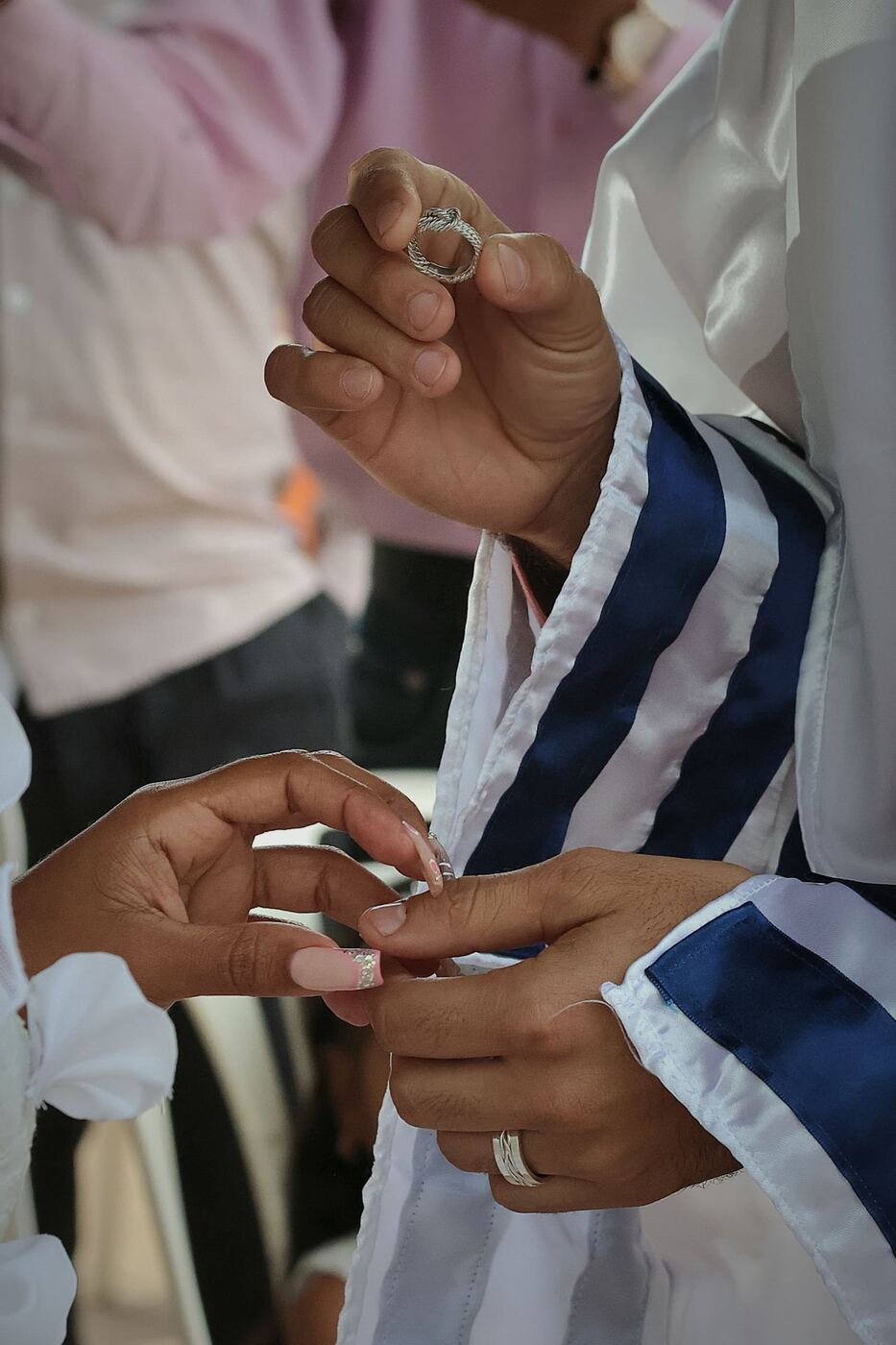
The Jewish Wedding Ring: Why It Is Plain and How It Is Given
Jewish wedding ring rules: why it is a plain band, who must own it, which finger it goes on and the words the groom says. Ask Chabad of Lamorinda.
On this page · 3 min read
Why is a ring given at all?What kind of ring is correct?Which finger does it go on?How does it go, step by step?A Jewish wedding ring is a plain, smooth band, with no stones, that belongs to the groom and that he gives to the bride under the chuppah. The ring is the heart of the betrothal (kiddushin), the first of the two stages of a Jewish marriage.
Why is a ring given at all?
Jewish tradition explains that a Jewish marriage has two parts: kiddushin (betrothal) and nissuin, the nuptials under the chuppah. Both are needed for a valid marriage. The groom gives the bride something of value, and today this is a ring. It is done before two witnesses, and the bride accepts it. He says: "You are hereby betrothed unto me with this ring in accordance with the laws of Moses and Israel." The ring is a "money equivalent," one of the traditional ways a marriage is made, and the only one practiced today.
What kind of ring is correct?
Jewish law gives these requirements:
- It belongs to the groom. The ring must belong exclusively to the groom as his gift to the bride. If parents buy it, it must be given to the groom as an unconditional gift before the chuppah. Using the bride's own engagement ring is discouraged. Jewish tradition says a groom may borrow a ring on condition that he returns it after the wedding, but this has details, so speak to the Rabbi before using one.
- Plain metal, usually gold. The band should be plain, preferably gold. In some circles silver is customary.
- No stones, no inscription. It should be a smooth, unbroken circle. The reason is so that the bride cannot be misled about its value, and so that the marriage is not based on a misunderstanding. A diamond ring may be given later, for example in the yichud room.
- Real value. It must be worth something, though Jewish law asks only for a small amount, the value of a perutah, a tiny coin.
Which finger does it go on?
The tradition says the groom puts the ring on the bride's index finger, not the ring finger. One reason given is that she can more easily show the witnesses that she received the ring; another view holds that the index finger was once the ring finger, and the custom stayed. After the ceremony she can move it to the ring finger.
How does it go, step by step?
- The groom says the formula first, then places the ring.
- Two designated witnesses watch the ring being given and hear his words.
- The bride's silent acceptance completes it. Customarily the bride lifts her veil at this point (see The bedeken), though in some Chassidic communities she keeps it down until after the nuptials.
The bride should not give the groom a ring under the chuppah. If they wish, it can be given later. There are no rules for a groom's own ring, because it is not part of the ceremony. The tradition holds that the bride and groom wear no jewelry to the chuppah.
In Lamorinda: Choosing a ring in Lafayette, Moraga or Orinda? Call Rabbi Labkowski at 925-384-7242 before you buy.
Common questions
Why is a Jewish wedding ring plain?
So the bride cannot be misled about its value, and the marriage is based on a simple, honest gift.
Does the ring have to be gold?
Gold is preferred, and some customarily use silver. Ask the Rabbi about your choice.
Why is the ring put on the index finger?
It makes it easier to show the witnesses that she received the ring. She may move it afterward.
Can the bride give the groom a ring under the chuppah?
No. The tradition says she should not do so under the chuppah, but may give one later.
Can the ring have diamonds?
Not the ceremonial ring. A diamond ring may be given later, for instance in the yichud room.
What does the groom say when giving the ring?
He says that the bride is betrothed to him with this ring according to the law of Moses and Israel. The Rabbi will guide you through the exact words.
Take the next step
- See the ring in the whole ceremony in The Jewish wedding, and the contract in The ketubah.
- Check off every item in the Jewish wedding planning checklist.
- Choosing a ring near Lafayette, Moraga or Orinda? Call Rabbi Labkowski at 925-384-7242 before you buy.
Questions about this, or something on your mind? Message the Rabbi or the Rebbetzin privately, or call 925-384-7242. · Email
Read next
 The Jewish Wedding: Traditions and Ceremony Explained Step by StepA step-by-step guide to the Jewish wedding: the ketubah, chuppah, ring, seven blessings, breaking the glass, and what they mean.Read next →