

Parashat Vayeilech
Deuteronomy · Deuteronomy 31:1-31:30
Parashat Vayeilech וילך
Moses, now one hundred and twenty years old, tells the people that he will not cross the Jordan with them, but G-d Himself will go before them, and Joshua will lead them. Before all Israel he tells Joshua: Be strong and courageous, for G-d will be with you; He will not fail you or forsake you. Moses writes the Torah and gives it to the priests and the elders. He commands the mitzvah of Hakhel: once every seven years, on Sukkot after the Sabbatical year, all the people, men, women, children and strangers, are to gather to hear the Torah read by the king. G-d tells Moses that after his passing the people will stray, and at times He will hide His face from them. He commands Moses and Joshua to write down the song of Ha'azinu as a witness that will never be forgotten by their descendants. The Torah scroll is placed beside the Ark of the Covenant.
A lesson for today
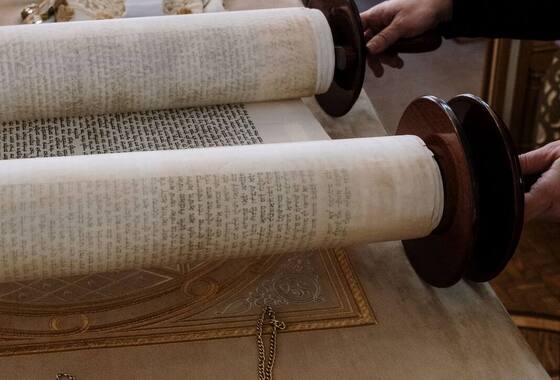
The last of the 613 commandments, found in this portion, is that every Jew should write a Torah scroll. The Rebbe launched a campaign for every Jewish child to own a letter in a communal Torah scroll, so that each child is literally written into the Torah. A Torah scroll is invalid if even one letter is missing, and in the same way the Jewish people is complete only when every single Jew is included. Each of us is a letter, and each of us is needed.
The Rebbe's teachingA storyIdeas for the Shabbat tableAn essay
The Rebbe's teaching
The Rebbe taught that Judaism lasts when it is lived as a personal experience, not only studied as history, and that the mitzvot of Hakhel and writing a Torah scroll are meant to help each of us relive Sinai.
Vayeilech contains the mitzvah of Hakhel: once every seven years, the whole people, men, women, children and converts, gathered in the Temple to hear the king read from the Torah. It also contains what Maimonides understands as the last of the 613 commandments, that every Jew should write a Torah scroll. In a talk published in Likkutei Sichos, the Rebbe asked what these two mitzvot have in common.
His answer is that Judaism works by bringing the past into the present. The Torah does not ask us to study history; it asks us to remember. History can be dry fact. Memory is lived experience that includes me. Jewish practice is full of reenactment: we sit in a sukkah to feel the desert journey, recline and eat bitter herbs at the Seder, stay up all night on Shavuot. Each of us, our teachers say, was present at Sinai in soul, and the Torah speaks to each person in the singular.
Hakhel was a communal reenactment of Sinai, and children were included because they, too, have a soul. But Hakhel took place only at the Temple. The personal Torah scroll carries the same encounter into every home and every generation.
The Rebbe's point, as Chabad teachers explain it, is that Judaism taught as a living experience endures, while Judaism taught as a dead subject is fragile. For parents and teachers, the message is to let children taste Shabbat, holidays and mitzvot, not only hear about them.
In his talks and letters about Hakhel, the Rebbe also taught that its message today includes Jewish education for young people and for adults who missed it as children, and that no one is ever beyond reach. It is never too late to begin. See the guides on the Torah scroll and a letter in a Torah.
A story
A well-known story; its details cannot be confirmed. It is told about the Baal Shem Tov.
The Baal Shem Tov, the founder of the Chassidic movement, spent his life traveling to Jews in small villages and towns. Someone asked him why he did not do what a rabbi was expected to do, and sit in his study learning Torah.
He answered that every Jew is a letter in the Torah scroll. A Torah scroll is invalid if even one letter is missing or erased. In the same way, the Jewish people, a living Torah scroll, is incomplete if one Jew is missing. And so, he said, he travels around restoring Jews to their place in the Torah.
The story helps us understand what drove the Rebbe, who sent emissaries to Jewish communities all over the world. The same idea of every Jew as a letter is at the heart of the Rebbe's campaign to give every Jewish child a letter in a communal Torah scroll.
Ideas for the Shabbat table
- Ask everyone: which of our family customs make you feel you are part of something bigger, and which ones do you remember from your own childhood?
- For children: if you could write one letter in a Torah scroll, which letter would you pick, and why? What would you like the Torah to say about our family?
- Adults: what is the difference between "history" and "memory"? Which Jewish moment have you experienced, not just heard about?
- Discuss: why did the Torah insist on including children in Hakhel, even when they are too young to understand everything?
- Talk about it: the letter story says that one missing person makes the whole incomplete. Who in our community or family may feel they are not needed?
- Try this: invite a guest, or call a relative, to join a Shabbat meal this week. Everyone matters. See also the Ten Days of Repentance.
An essay
Think of the last time you truly remembered something. Not looked at a photo, but felt your way back into it. The smell of your grandmother's kitchen, the sound of a voice. A memory like that is not a fact in the past; it is present again.
Vayeilech is about exactly this. Moses knows that he is about to die, and the Jewish people will cross the Jordan without him. His last mitzvot are not about doing a deed once and finishing. They are about making sure the story never becomes only a story. Every seven years, the entire people stand together as if at Sinai. And each person, finally, is commanded to write a Torah of his own.
The Rebbe saw in this a message that is practical for any family. We cannot pass on Judaism simply by explaining it. We pass it on by letting our children smell the challah, light the candles, hear the shofar, sit in the sukkah. These are our reenactments. They turn the past into a living presence.
And there is a quieter message in the Rebbe's teaching: no one is ever beyond reach. A person who did not learn as a child, a family that drifted, a year that went badly, none of them is beyond repair. The Baal Shem Tov's story tells us why. Every Jew is a letter in the Torah, and a letter that has faded or been neglected is still part of the scroll.
So the question for this Shabbat is both simple and personal: which Jewish experience can we invite into our home this week? Not in theory, but with our hands and our table.
If you would like help with that, come to Shabbat at Chabad of Lamorinda in Lafayette (call 925-384-7242 for the times) or join the Wednesday 1:00 PM Tanya class at the Rabbi's home (call for the address). Families from Lafayette, Moraga and Orinda are welcome.
Common questions
What is Parshat Vayeilech about?
Parshat Vayeilech (Deuteronomy 31:1-30) is Moses' last day: he tells the people he will not cross the Jordan, encourages Joshua, gives the mitzvah of Hakhel, and commands that the Torah and the song of Ha'azinu be written.
What does the Rebbe teach about Parshat Vayeilech?
The Rebbe teaches that Hakhel and writing a Torah scroll help each Jew relive Sinai, and that Judaism taught as a living experience endures. He also encouraged every Jewish child to have a letter in a communal Torah scroll.
What is the main lesson of Parshat Vayeilech?
Every Jew is a letter in the Torah: each one is needed, and no one is ever beyond reach. See the weekly parsha for ways to study each portion.
Learn more
 The Weekly Parsha: How the Torah Is Read Each WeekWhat the weekly Torah portion (parsha) is, how the 54 portions fit the Jewish year, and easy ways to study and discuss the parsha each week.
 The Torah Reading in Synagogue: When, Why and HowWhen the Torah is read in synagogue, how the weekly cycle works, what happens during the reading, and what to do as it takes place.
 The Haftarah: What It Is and Why We Read ItWhat the Haftarah is, how it began, how it connects to the weekly Torah portion, who reads it, and what to know for a bar mitzvah.